

All sales representatives have one goal, and that’s selling. Yet, many salespeople are occupied with admin activities. They have less time to concentrate on sales tasks such as entering leads’ information or sending follow-up emails, making changes to CRM data, and generating quotations.
To address these problems, Businesses are shifting towards automation as it helps save time on manual labor, decreases mistakes, and speeds up interactions with customers. In this guide, you’ll learn more about Sales Automation in detail and the best tools to aid with business growth.
What is Sales Automation?
Sales Automation refers to the use of the right tools to handle repetitive tasks automatically, such as lead data, sending follow-up emails, tracking pipeline stages, scheduling reminders, generating quotes, updating customer records, etc.
Traditionally, salesperson does all these tasks; with the integration of automation tools, salespeople get more time to focus on selling.
According to McKinsey, around one-third of sales operations can be automated using machine learning, robotics process automation, natural language processing, smart workflows, and virtual agents.
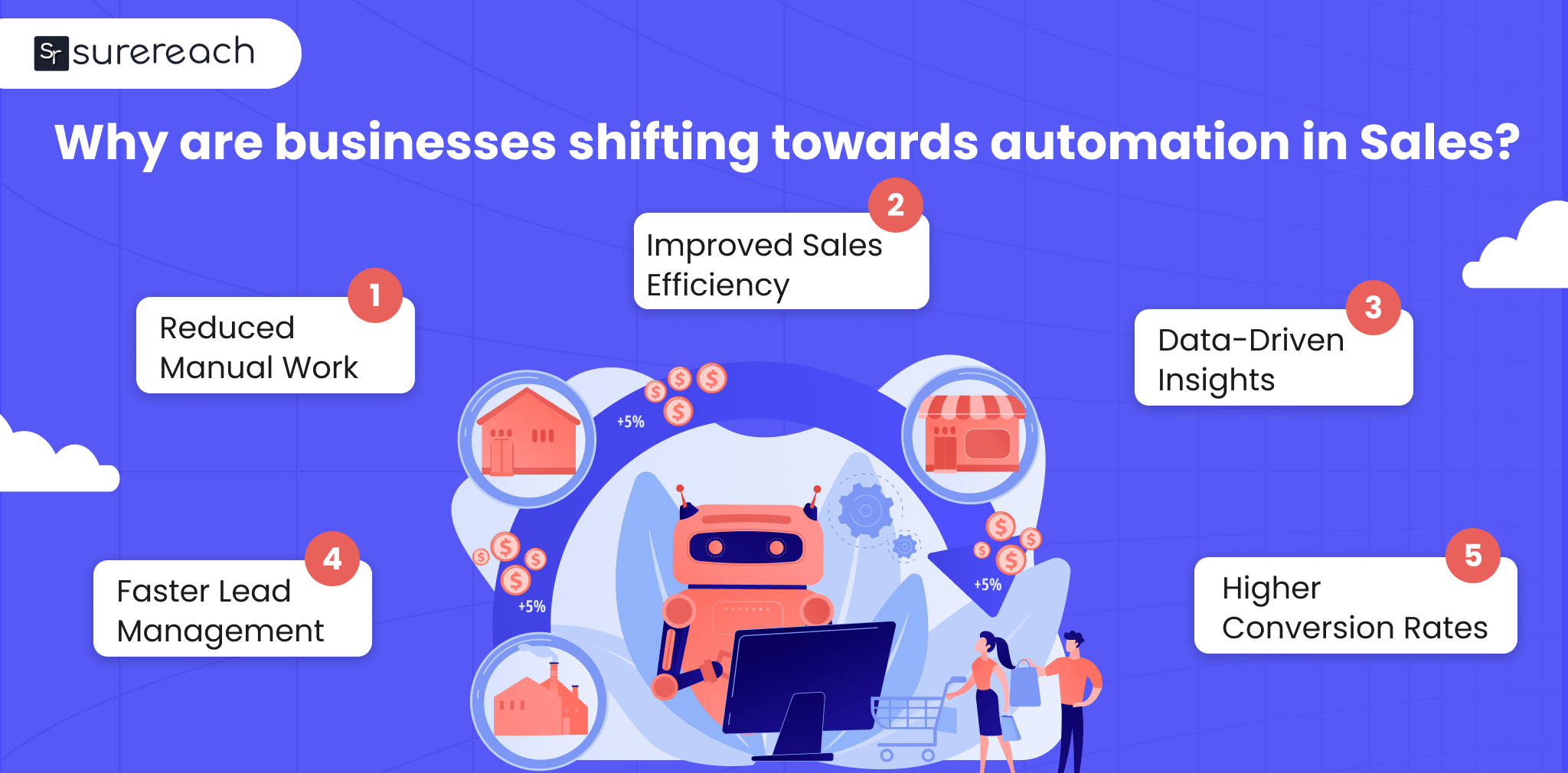
Why are businesses shifting towards automation in Sales?
Businesses are shifting towards automation due to several reasons:
- Reduce the time spent and the manual work
Sales reps spend a lot of time doing administrative duties (data entry and reminders). Automation takes care of the entire process and can save them numerous hours of their time.
- Increase accuracy and reduce errors
Manual entry of data can lead to errors (work contacts, incorrect information, and delayed reminders). Automated systems ensure accuracy, consistency, and up-to-date information.
- Faster follow-ups, better lead management
Automated reminders, follow-up email leads scoring, as well as nurture sequences. This helps to ensure that no leads are lost in the shuffle.

Benefits of Sales Automation
The main advantages of automation in sales:
- Saves Time and Reduces Repetitive Tasks: It automates tasks like follow-up emails, data entry, and meeting reminders, freeing the sales team to focus on high-value activities.
- Improve Lead Conversion and Customer Relationships: Automation confirms that no lead is missed and every prospect gets timely communication. It helps the team convert more leads into loyal customers.
- Boosts Sales Team Productivity: It streamlines processes, and sales reps can work more efficiently, spending less time on admin work.
Sign up and get 20 credits for free!
We have 3 million+ contacts stored to connect you with prospects all over India
Top CRM Tools with Built-in Sales Automation
These are the most popular tools:
- Salesforce
It offers features like lead scoring, predictive analytics, data enrichment, and compliance checks. It smoothly integrates with sales and marketing tools. Suitable for medium to large enterprises.
- HubSpot Sales Hub
It offers features like automated email sequences, follow-up tasks, lead scoring, and activity logging. Apart from this, it offers conversational AI (ChatSpot) for automated insights and integrations.
- Zoho CRM
It offers workflow automation, AI-powered insights, lead scoring, and omnichannel automation. It also includes automated data enrichment and predictive sales signals. It is affordable, highly customizable, AI-enabled, and has smooth integration.
- Pipedrive
Pipedrive focuses on sales pipeline automation with customizable stages, and automated activity reminders. It also includes sales forecasting and workflow automation.
- LeadSquared
It focuses on sales and marketing automation with automated lead capture, assignment, and nurturing. It also includes workflow automation and mobile CRM capabilities. It offers affordable pricing and lead management.
How to Implement Sales Automation Successfully?
Here is a step-by-step process to do it:
Identify Repetitive Sales Tasks
First and foremost, list down all activities that the sales team repeats daily. It includes follow-up emails, logging calls, updating lead status, or scheduling meetings.
Choose the Right Software
Not all automation tools are the same. Look for software that:
- Integrate with your existing CRM and communication tools.
- Easy-to-use workflows.
- Offers analytics to check results.
Train Your Sales Team
It is important for your team to know how to use it effectively. Provide training sessions, video tutorials, or even short checklists so your team understands:
- Which tasks are automated
- How to use the tool for daily activities
- How to personalize customer reach
Conclusion
Sales automation is not an option. It is a necessity that every business should have in its sales workflow. As administrative work consumes so much time of sales representatives, sales automation is required to give them enough time to focus on the sales. With the right tools and implementation, business can significantly improve their revenue and growth.
FAQs
What is Sales Automation?
It refers to the right use of software that eliminates repetitive tasks.
How to automate your sales?
You can automate the sales process by identifying repetitive tasks, data entry, and email outreach.
Can Sales Automation replace sales representatives?
No, automation helps the sales team by handling repetitive tasks.
What is the main purpose of Sales Automation?
Its main purpose is to improve productivity and make the sales representatives free from administrative burden.
Can Sales Automation improve customer experience?
Yes, it improves customer experience by providing fast responses, personalized emails, timely follow-ups, etc.


Vijay kandari
Vijay Kandari is part of the marketing team, driving brand growth and digital campaigns. He is passionate about automation, digital transformation, and the evolving trends shaping the future of customer onboarding and verification.
More posts by vijay kandari