

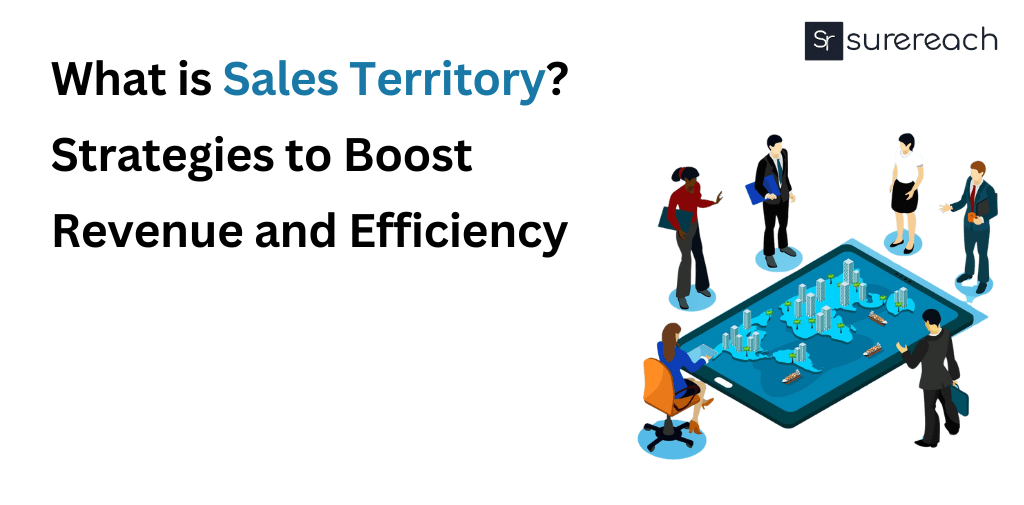
As a business, are you sure your sales team is stepping on each other’s toes? Are your sales teams working well? Are there some regions that are underperforming and others that are saturated? It is a common problem of undefined sales territories.
In simple words, a sales territory is a geographic area, a market segment, or a customer group given to a specific salesperson or team. Here, in this blog, you will learn how to create an effective sales territory.
What is Sales Territory?
It is a specific group of customers or a specific geographic area that is assigned to one salesperson or sales team. Every salesperson calls on every customer. It is divided into smaller and manageable pieces.
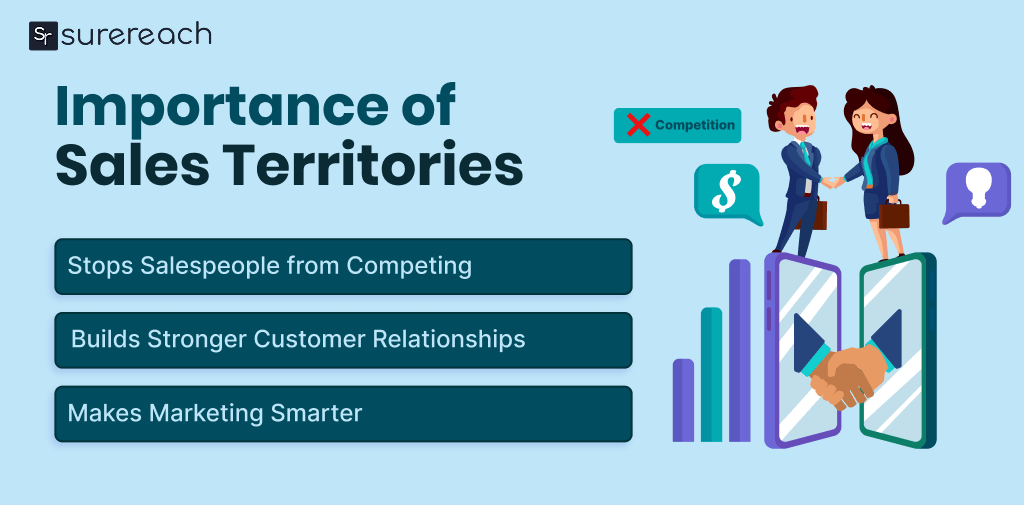
Importance of Sales Territories
Using territories is like giving everyone a clear game:
- Stops Salespeople from Competing: Each person has their own customer and their own area to focus on. They don’t accidentally try to sell to the same client as coworkers.
- Builds Stronger Customer Relationships: When a salesperson handles the same clients regularly. They get to know their needs better.
- Makes Marketing Smarter: The Company can create specific marketing messages for each territory since it knows the customers there.
Sign up and get 20 credits for free!
We have 3 million+ contacts stored to connect you with prospects all over India
Steps to Create a Sales Territory Plan
These are the main steps to create a plan:
-
Decide Which Regions to Focus On and Distribute Resources
Find out where the most leads originate from. Which area has the greatest chance of generating sales. This will assist you in deciding which areas to allocate more resources, such as representatives for sales or marketing.
-
Divide Your Customers into Groups
When you’ve identified your target area and the target market, divide your customer base into smaller sections for better targeting. They can be divided by location, industry, or even the size of the company, for example, small, medium, and large companies.
-
Make Region-Specific Strategies
Different regions have different needs, so your sales approach should not be the same everywhere. Customize message, pricing, and overall strategy fit to rules.
-
Define Your Ideal Customer Profile
If you want to sell effectively, you need to understand your customers. You can use data to figure out what makes an ideal customer for your business. Look at factors like how engaged they are, their lifetime, and whether they align with the product or service. ICP helps target prospects that are most likely to convert and bring long-term value.
-
Plan How to Assign Accounts
After defining your ICP, plan how to distribute accounts among the sales team. Ensure that each representative gets a fair share and can handle their workload. Understand experience, language skills, and knowledge of a particular region. This way, every account gets proper attention.
-
Set Metrics and Quotas
When you’ve identified your target area and the target market, divide your customer base into smaller sections for better targeting. They can be divided by location, industry, or even the size of the company, for example, small, medium, and large companies.
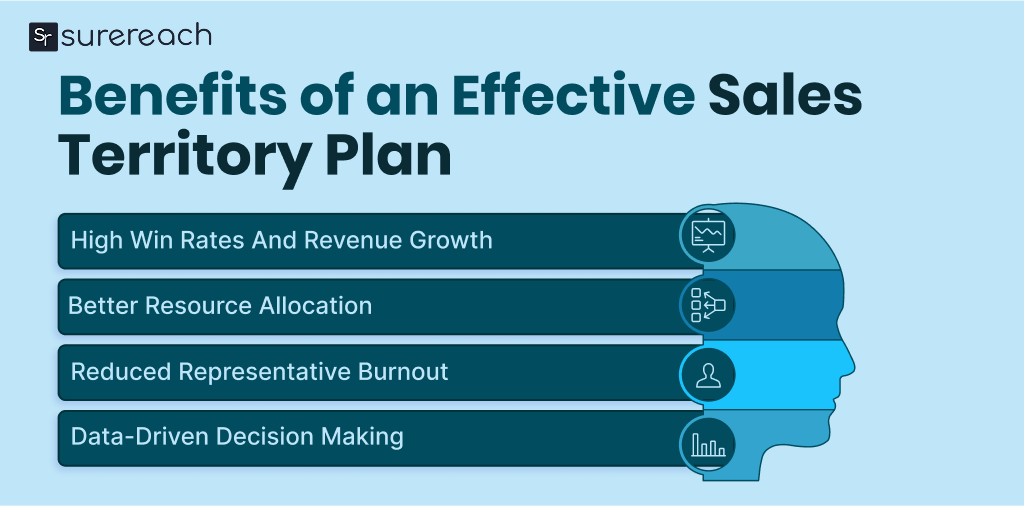
Benefits of an Effective Sales Territory Plan
A Sales Territory plan offers several advantages that directly impact revenue and team performance:
-
- High Win Rates And Revenue Growth: It focuses on the right territories that leads to better conversion.
- Better Resource Allocation: It confirms that sales representatives and marketing resources are distributed where they can make the most impact.
- Reduced Representative Burnout: A balanced workload prevents overloading certain representatives while other reps have nothing to work on.
- Data-Driven Decision Making: It helps track performance and adjust strategies based on real insights.
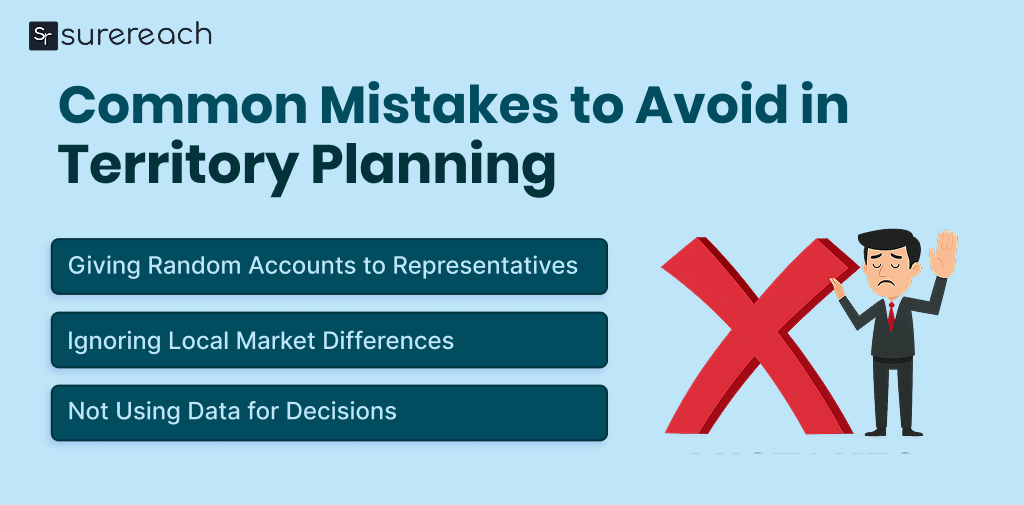
Common Mistakes to Avoid in Territory Planning
These are the common mistakes you should avoid while planning:
-
Giving Random Accounts to Representatives
One of the biggest errors the department makes is to assign accounts with no strategy. Random distribution results in unbalanced workloads and wasted time. Sales representatives who are successful may have clients with high potential, while other sales representatives struggle with less-profitable prospects. This causes frustration and reduces the overall efficiency.
-
Ignoring Local Market Differences
You need to understand the region. Ignoring cultural differences, buying behaviours, and local laws can reduce your sales efforts.
-
Not Using Data for Decisions
Don’t analyze past performance, conversion rates, and customer data; your territory plan will lack focus. It helps you identify which region offers the most potential, and customers are most likely to buy.
Best Practices for a Winning Territory Strategy
These are practices for winning a territory strategy:
-
Use CRM and Analytics Tools
An effective CRM system can help keep track of customer information, interactions, as well as sales. Analytics tools help discover trends and pinpoint areas that are likely to be the most profitable.
-
Revisit and Update the Plan Regularly
Markets change, customer needs change, and every day, competitors enter the space. A territory plan should never be static. Review it quarterly or biannually to confirm your strategies still align with business goals and market realities.
-
Train Representative for Cultural and Regional Differences
If you are working across several locations, differences in culture could affect the way prospects react to sales messages. Make sure your sales representative is aware of regional customs, styles of communication, as well as legal regulations.
-
Align Marketing and Sales for Consistent Messaging
Your sales and marketing teams must work together in order to make sure that your message remains consistent across the entire territory.
Conclusion
A well-designed sales territory strategy is crucial for resource management and enhancing revenue. When defining their territories, companies are able to reduce internal competition, improve customer satisfaction, and offer specific strategies to different regions. An organized plan can maximize potential sales and also support the use of data to make decisions.
FAQs
Q.1 How to Identify Sales Territories?
Ans: You can identify sales territories by dividing regions or customer groups on geography, demographics, or market potential.
Q.2 How important is territory in Sales?
Ans: It helps avoid overlap, confirms fair distribution, and enhances sales efficiency.
Q.3 What is the purpose of a sales territory?
Ans: It assigns specific areas or customer segments to salespeople for better focus.
Q.4 How to create a sales territory?
Ans: First, analyze market data, segment customers, and assign areas based on potential and resources.
Q.5 How to manage sales territories?
Ans: Regularly monitor performance, adjust assignments, and balance workload.




Ashish Kesharwani
Digital Marketer at Surereach, specializing in creating compelling content and executing effective digital strategies.
More posts by Ashish Kesharwani