

Does your firm invest so much in marketing and Ads (Google, Facebook, and Instagram)? But do you have any Idea how it is actually working? Do you just increase clicks or do they contribute to revenue? This is where Return on Ad Spend (ROAS) comes in. It is the fundamental metric that separates vanity metrics from true business growth. In the following guide, we will discuss ROAS, its calculation, and advanced strategies.
What is ROAS?
ROAS or Return on Ad Spend. In simple words, it is a metric that helps measure the revenue earned for every rupee you spend on advertising. Think, if you spend Rupees 100 on a lottery ticket and win over Rupees 500. Your ROAS is 5:1. Its main job is to check the immediate effectiveness of a campaign, ad group, or keyword.
ROAS Formula
The Return on Ad Spend (ROAS) formula is straightforward. You can calculate it by dividing the revenue generated from your advertising campaign.
The Basic ROAS Formula:
ROAS = (Revenue from Advertising) / (Cost of Advertising)
How to Calculate ROAS with an Example?
Let’s understand with an example:
This is a standard way marketers discuss ROAS. A ROAS of 5:1 means you earn ₹5 for every ₹1 you spend.
Example:
Money you spend on Google Ad = ₹10,000
The campaign will generate ₹50,000 in Sales.
ROAS = ₹50,000/ ₹10,000 = 5
ROAS will be 5:1.
Percentage
Formula: (Revenue/Cost) *100
Example (using the same numbers): (₹50,000/₹10,000)*100 = 500% ROAS
Decimal (or Multiple)
This is the raw number from the division. A ROAS of 5 means your revenue was 5 times your ad spend.
Example: ₹50,000 / ₹10,000 = 5
| Campaign | Ad Spend | Revenue Generated | ROAS (Ratio) | ROAS (%) | ROAS (Decimal) |
| Diwali Sale | ₹20,000 | ₹10,00,00 | 5:1 | 500% | 5 |
| Brand Awareness | ₹15,000 | ₹30,000 | 2:1 | 200% | 2 |
| New Product Launch | ₹50,000 | ₹75,000 | 1.5:1 | 150% | 1.5 |
Sign up and get 20 credits for free!
We have 3 million+ contacts stored to connect you with prospects all over India
Return on Ad Spend vs ROI
ROI
ROI, or Return on Investment, is a measure that tells about the overall profitability of an investment. It calculates how much net profit you have earned compared to the total cost of the investment.
Formula:
Suppose you invest in a small tea shop:
Cost of Investment: ₹50,000
Net Profit: ₹10,000
ROI = Net Profit/Cost of Investment ×100
ROI=10,000/50,000×100 = 20%
Key Difference Between ROAS and ROI
| Aspect | ROAS (Return on Ad Spend) | ROI (Return on Investment) |
| Focus | Revenue generator per unit of ad spend. | Overall profitability of an investment. |
| Formula | Revenue from Ads ÷ Cost of Ads | (Net Profit ÷ Total Investment) × 100 |
| Include Cost | Only considers advertising costs | Considers all costs (products, overhead, salaries, etc.) |
| Purpose | Measures ad efficiency | Measures total profitability |
| Perspective | Short-term campaign performance | Long term business growth |
What is Good ROAS?
A good ROAS is Return on Ad Spend totally depends on industry, business model, and campaign goals. Usually, a ROAS of 3:1 or higher is considered healthy. This means your ad campaigns are generating enough revenue to cover ad costs and contribute to profitability.
Strategies to Improve ROAS
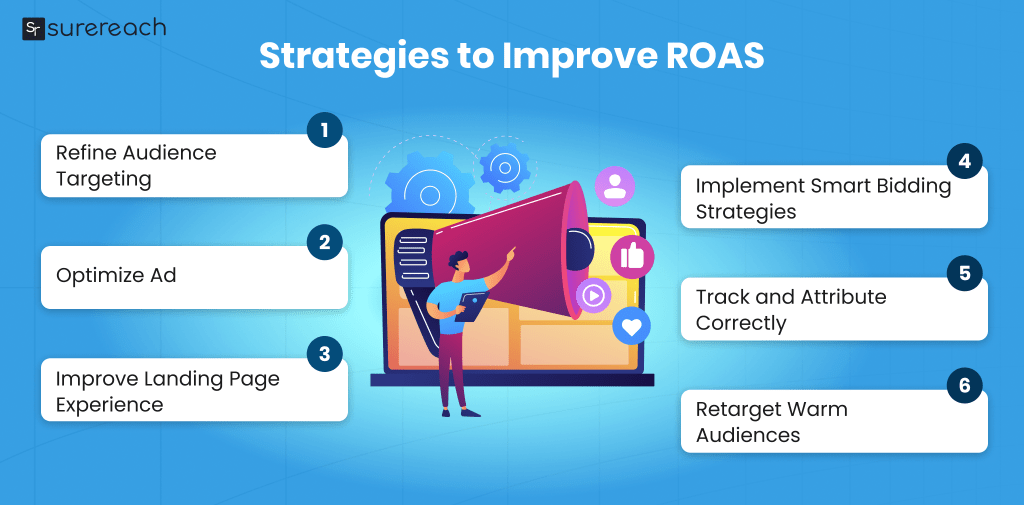
Improving your Return on Ad Spend (ROAS) means getting revenue from every dollar you put into advertising.
- Refine Audience Targeting: To get high revenue, you need to target the right customers. You should use advanced targeting options like demographics, interests, and behaviors. Use lookalike or custom audiences based on existing customers. Remove unnecessary or irrelevant audience. It will reduce the waste.
- Optimize Ad: Test different ad formats (video, carousel, and static). Try to use good visuals and compelling ad copy with clear CTAs.
- Improve Landing Page Experience: It confirms fast loading speed and a mobile-friendly design. Use persuasive copy aligned with your ad messaging. Simplify checkout or lead-capture processes to boost conversion.
- Implement Smart Bidding Strategies: Use automated bidding platforms like Google Ads (Target ROAS, Maximize Conversion). Try to adjust the bid for high-performing keywords and audience segments. It will reduce spending on underperforming placements.
- Track and Attribute Correctly: Set up accurate conversion tracking. Use multi-touch attribution models instead of last-click. Evaluate customer lifetime value (CLV) to avoid undervaluing campaigns.
- Retarget Warm Audiences: Retarget visitors who abandoned carts or browsed product pages. Create personalized ads with offers to bring them back. You can use dynamic retargeting to showcase products people engaged with.
- Shift Focus on High-Performing Channels and Campaigns: Thoroughly analyze channel performance regularly, including Google, Facebook, LinkedIn, etc. Spend more on ads that are delivering higher ROAS. Stop or rework on low-performing campaigns.
Common Mistakes When Measuring ROAS
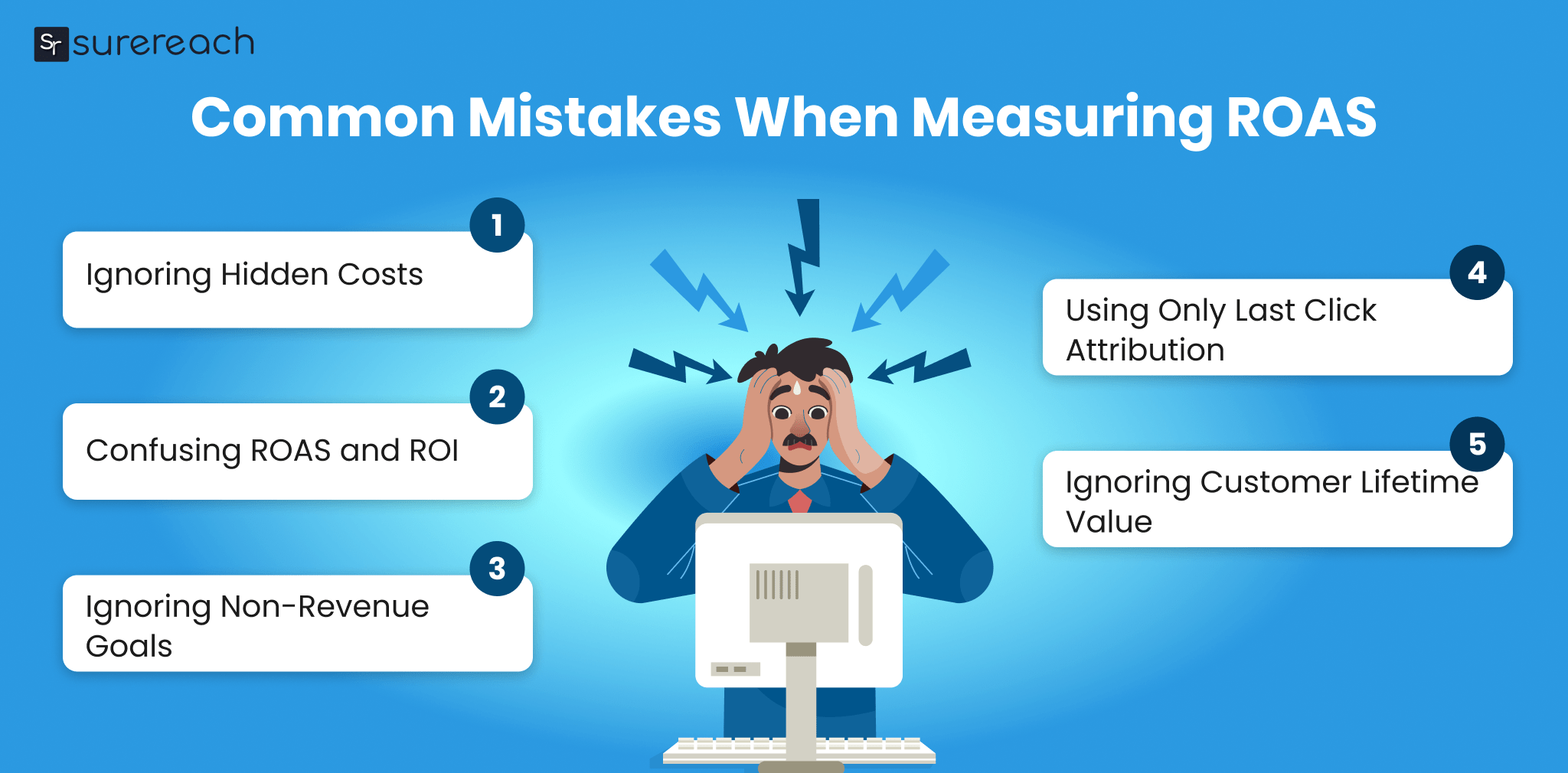
Here are the most common mistakes you should avoid:
Ignoring Hidden Costs: Most of the marketers only compare ad spend and revenue, ignoring costs like:
- Products costs
- Shipping and Handling
- Platforms Fees (Google Ads, Facebook Ads, etc.)
- Agency or creative expenses.
Confusing ROAS and ROI: ROAS measures revenue generated directly from ad Spend. ROI measures overall profit after subtracting all costs. It focuses on ROAS may give a false sense of profitability if margins are thin.
Ignoring Non-Revenue Goals: Some campaigns are made to make people aware of your product and services. Judging these campaigns only by ROAS undervalues their impact on the full customer journey.
Using Only Last Click Attribution: Many businesses rely solely on last click attribution. It credits the final touchpoint before a conversion. This will ignore the contribution of the awareness campaign.
Ignoring Customer Lifetime Value (CLV): A campaign might look unprofitable on a first purchase. However, profitable when you factor in repeat purchases. Ignoring CLV leads to under-investing in campaigns that bring high-value customers.
Conclusion
ROAS is an essential part of the marketing Campaign. It helps track the money spent and its contribution to the generation. You can calculate ROAS through the formula with an example. People often get confused about ROI and ROAS. These terms correlate to returns, but in a different way. You should use the right strategies to increase.
FAQs
What does 2.5 ROAS mean?
It means that every rupee you spend on advertising, you earn 2.5 in revenue.
What is return on ad spend in Google Ads?
It is a metric that helps measure for each rupee spent on advertising.
What is a good return on advertising spend?
4:1 is considered a good return on advertising spend.
How do I calculate ROAS?
You can calculate ROAS using its formula ROAS = Revenue Generated from Ads / Ad Spend.
What does 50% ROAS mean?
It refers to the loss where you spent 1 rupee and got only 0.50 rupee in return.




Vijay kandari
Vijay Kandari is part of the marketing team, driving brand growth and digital campaigns. He is passionate about automation, digital transformation, and the evolving trends shaping the future of customer onboarding and verification.
More posts by vijay kandari